Showing posts with label gender stereotypes. Show all posts

Monday, June 30, 2008

Exploring Gender Cross-Culturally: Persia/Iran

Thought it might be interesting to introduce other worldviews of gender during July. By comparing our norms and expectations of the relations between the sexes we gain the most insight into our own (not the other's). This is from Encyclopedia Iranica.

About the photo below: An Iranian woman veiled in modern fashion crosses a street in Tehran, 24 October 2006. From body-covering black chadors to colourful headscarves, the wearing of the veil is obligatory for all mature women in Iran, even though there is now a striking diversity in how it is observed. AFP PHOTO/BEHROUZ MEHRI

GENDER RELATIONS
Although belied by a more complex social reality and beneath temporal and local variations, three interrelated patterns permeate gender relations in contemporary Persia. They are (1) segregation of the sexes, (2) male domination/female subordination, and (3) the primary role of woman as wife and mother within the family unit.

SEGREGATION OF THE SEXES

In addition to divides defined by class, religious, ethnic, and generational differences, there has existed in Persia another division of the social order, one based on sex. This axis, around which society was, and, to a certain extent, continues to be organized, kept the world of men and women apart. Traditionally, men engaged in activities outside the house in the public sphere of politics and the market place. The world of women, on the other hand, was indoors. It was private and domestic.

One of the most compelling justifications for sex-segregation has been the belief that sexual desire is easily stimulated in both sexes and, if unregulated, can cause social mayhem and disorder. To channel sexual conduct properly, various forms of physical and symbolic barriers were created between the two sexes. To protect the integrity of the male line of descent, women's sexuality was closely monitored and contained. ...

Women's chastity has been inextricably linked with space. While mobility has always been valued and admired in men, it has often been associated with opportunity for sexual promiscuity in women. Kò^a@ba@ngard (street-walker), velgard (vagrant), and harja@÷^ (belonging or existing everywhere) are terms synonymous with prostitution when applied to women. Gomra@h kardan and az ra@h ba dar bordan (leading astray) are equivalent to seducing. The veil (see ÙADOR), the most conspicuous expression of sex-segregation, like the hymen (parda-ye bekarat), is perceived to be a physical impediment, an obstacle to men's and women's sexual temptation.
What is the most conspicuous expression of sex-segregation in American culture?
Is there something or some context analagous to the veil in U.S. society or within black culture??
  • Bathrooms?
  • Saunas?
  • Music production?
  • Genres of music and literature
  • Pornography (for men v. women on sale at news-stands)

Wednesday, June 18, 2008

R Kelly Verdict: Black Men Speak Out

Spelman Professor and Journalist Jelani Cobb, a colleague and friend, shared this piece today. I am posting it in response to the verdict in the 5-week R Kelly child prnography case. View several videos about the case and fan reactions at ChicagoTribune.com.

I was appalled. I heard some jurors felt the 13-year seemed too developed to give her case credibility though she never testified in court and she denied it was her on the tape. What could the jurors do with that. But some are suspicious of the circumstances anyhow.

Check this statement out by Jelani and the brothers who contributed to BE A FATHER TO YOUR CHILD that I wrote about a couple days ago.
Dear Friends:
I am one of the contributors to the anthology Be A Father to Your Child, which focuses on encouraging healthy fatherhood development in the black community. We felt it necessary to issue the following statement and petition in response to the recent verdict in R. Kelly's child pornography trial.

Please read and, if you agree, sign and forward this to your networks.

Sincerely,
Jelani Cobb

Statement of Black Men Against the Exploitation of Black Women

Six years have gone by since we first heard the allegations that R. Kelly had filmed himself having sex with an underage girl. During that time we have seen the videotape being hawked on street corners in Black communities, as if the dehumanization of one of our own was not at stake. We have seen entertainers rally around him and watched his career reach new heights despite the grave possibility that he had molested and urinated on a 13-year old girl. We saw African Americans purchase millions of his records despite the long history of such charges swirling around the singer. Worst of all, we have witnessed the sad vision of Black people cheering his acquittal with a fervor usually reserved for community heroes and shaken our heads at the stunning lack of outrage over the verdict in the broader Black community.

Over these years, justice has been delayed and it has been denied. Perhaps a jury can accept R. Kelly's absurd defense and find "reasonable doubt" despite the fact that the film was shot in his home and featured a man who was identical to him. Perhaps they doubted that the young woman in the courtroom was, in fact, the same person featured in the ten year old video. But there is no doubt about this: some young Black woman was filmed being degraded and exploited by a much older Black man, some daughter of our community was left unprotected, and somewhere another Black woman is being molested, abused or raped and our callous handling of this case will make it that much more difficult for her to come forward and be believed. And each of us is responsible for it.

We have proudly seen the community take to the streets in defense of Black men who have been the victims of police violence or racist attacks, but that righteous outrage only highlights the silence surrounding this verdict.

We believe that our judgment has been clouded by celebrity-worship; we believe that we are a community in crisis and that our addiction to sexism has reached such an extreme that many of us cannot even recognize child molestation when we see it.
We recognize the absolute necessity for Black men to speak in a single, unified voice and state something that should be absolutely obvious: that the women of our community are full human beings, that we cannot and will not tolerate the poisonous hatred of women that has already damaged our families, relationships and culture.

We believe that our daughters are precious and they deserve our protection. We believe that Black men must take responsibility for our contributions to this terrible state of affairs and make an effort to change our lives and our communities.

This is about more than R. Kelly's claims to innocence. It is about our survival as a community. Until we believe that our daughters, sisters, mothers, wives and friends are worthy of justice, until we believe that rape, domestic violence and the casual sexism that permeates our culture are absolutely unacceptable, until we recognize that the first priority of any community is the protection of its young, we will remain in this tragic dead-end.

We ask that you:
  • Sign your name if you are a Black male who supports this statement: http://www.petitiononline.com/rkelly/petition.html
  • Forward this statement to your entire network and ask other Black males to sign as well
  • Make a personal pledge to never support R. Kelly again in any form or fashion, unless he publicly apologizes for his behavior and gets help for his long-standing sexual conduct, in his private life and in his music
  • Make a commitment in your own life to never to hit, beat, molest, rape, or exploit Black females in any way and, if you have, to take ownership for your behavior, seek emotional and spiritual help, and, over time, become a voice against all forms of Black female exploitation
  • Challenge other Black males, no matter their age, class or educational background, or status in life, if they engage in behavior and language that is exploitative and or disrespectful to Black females in any way. If you say nothing, you become just as guilty.
  • Learn to listen to the voices, concerns, needs, criticisms, and challenges of Black females, because they are our equals, and because in listening we will learn a new and different kind of Black manhood
We support the work of scholars, activists and organizations that are helping to redefine Black manhood in healthy ways. Additional resources are listed below.

Books:
  1. Who's Gonna Take the Weight, Kevin Powell
  2. New Black Man, Mark Anthony Neal
  3. Deals with the Devil and Other Reasons to Riot, Pearl Cleage
  4. Traps: African American Men on Gender and Sexuality, Rudolph Byrd and Beverly Guy-Sheftall
  5. On Gender Relations & stereotypes (the issue is not limited to black masculinity and many women supported the R Kelly's verdict):
    The Games Black Girls Play: Learning the Ropes from Double-Dutch to Hip-Hop
    , Kyra D. Gaunt
Films:
  1. I Am A Man: Black Masculinity in America, by Byron Hurt
  2. Hip Hop: Beyond Beats and Rhymes, by Byron Hurt
  3. NO! The Rape Documentary, by Aishah Simmons
Organizations
  1. The 2025 Campaign: www.2025bmb.org
  2. Men Stopping Violence: www.menstoppingviolence.org

Monday, June 9, 2008

Policing the Social Construct of a Man's Role in Marriage

I don't usually pay much attention but I happened across the headline in a store the other day that caught my SUCCESS with the OPPOSITE SEX(TM) radar:
Mariah Carey treats new husband Nick Cannon like an assistant

Newlyweds Mariah Carey and Nick Cannon were enjoying a romantic dinner at Gyu-Kaku in LA when suddenly, the pop diva felt the urge to use the restroom. “She told Nick to escort her to the bathroom,” a witness at the restaurant on May 12 tells In Touch. “He walked here there, then waited outside the door. It was like he was on her security team.”

Insiders say that since the two married in the Bahamas on April 30, Nick seems more like Mariah’s employee than her spouse. “She treats Nick like an assistant,” says a friend of Mariah’s. “He’s not treated like her equal or her husband.” Nick also seems to be at Mariah’s beck and call. “He’s very attentive to her,” his pal… Kevin Frazier tells In Touch.
[From In Touch, print edition, June 2, 2008]

The article mentioned Cannon's age (27) and though Mariah's age is not revealed (how gracious of the writers), it was clear that all these details were there to support a cultural myth we have not about superdivas, but about men and their proper roles as the one wearing the pants in a relationship.

I recall when Brandy got married and MTV did a whole reality stint with them. I remembering noticing that her then young husband (now divorced) was not going to like the idea of being represented as a kept man. She kept calling him "pooky" and her voice dominated the narrative in the biopic. It was not long after they divorced. When I saw the piece on Mariah and Nick I thought here we go again.

I teach my anthro students about social constructs. I suggest they are like superstitions we live by like the earth being flat and they shape our thoughts and actions and feelings even though they are anything but true. Here the social construct is about masculinity. You can translate it into hip-hop/black terms "being p*ssy-whipped," "pimped," playin you like a b*tch". All these comments are what polices the boundary of an old antiquated and not real view of the way men should be with women. It's so outdated and doesn't allow for any individuality or self-expression.

A social contruct is "is a concept or practice which may appear to be natural and obvious to those who accept it, but in reality is an invention or artifact of a particular culture or society" (Wikipedia). The way men are or are supposed to be may seem natural but it is invented and could be interpreted any number of ways. These socially agreed upon constructs are often limiting and damage the possibility of having what one truly wants in life with one's partner.

What is masculinity to you? Surely your view is tainted with a social construct. Mine is. I love a man to walk on the outside of the sidewalk, open doors, pay for the dates, but that is not what makes him a man. Masculinity is just his expression. It may complement and overlap with what I express as a female, as femininity and it can even be something I've never imagined.

Tabloids will be tabloids. But will we have enough sense to not continue the superstition about the way we think men oughta be?

Wednesday, April 2, 2008

GENTLEMAN-LINESS vs. MASCULINITY

When talking about male gender stereotypes, we should first take a step back and ask ourselves: what is manliness, anyway? As we explore the answers to that question, it becomes obvious that definitions of manliness aren't always consistent between cultures. More important, though, is the fact that the definition of manliness isn't a static one: it has a tendency to change over time. As American society crosses into the 21st century, we are experiencing shifts in what gender stereotypes are socially acceptable. Gone are the days when little Jimmy would go outside to play stickball with his friends every afternoon. Today, the average male youth participates in a host of activities that transcend male and female lines. He talks about his feelings. He takes cooking as well as woodworking. For many, manliness is less about eating red meat and watching football, and more about gentleman-liness, for lack of a better term.

As American men search for what it means to be male, it become obvious that gender equality is not exclusive of gender identity and role. One blog, The Art of Manliness, embodies that new American male identity. Its writers focus on contemporary interpretations of the core values of masculinity, using them as a path to becoming a gentleman. I recommend the blog to anyone else - it's often a great read. Click here for The Art of Manliness blog.

Blog post created by Abraham H (a male student in my Anthropology course when we did a unit on gender)

KYRA: The one thing missing from the site recommended is...black people. But don't let that stop you from reading it. Might be that black folks need to read outside the box of blackness to say/do something new inside the gender game.

Thursday, March 27, 2008

Why do we love stereotypes? So we can settle on them being the truth (easy answers for relationships)?

ORIGINALLY POSTED 11/13/07 at 10:22am.

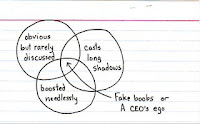
Over-inflated by Jessica Hagy

I was teaching my anthropology students about gender and one of the groups in the class came up with this YouTube video in Italian & English about stereotypes. I showed it to two sections of my course and in both cases I was amazed at how often students said "It's true!" Like seeing a video of stereotypes sets life aright. AHHH. There! It's gonna be alright.

But what of the exceptions among the 6.7 billion men and women on the planet? What of tomboys and men who love fashion (gay or straight)? Are they doomed to be wrong because they are not true to 'form' in the land of stereotyping? So much of what we relate to in relationships is based on stereotypical expectations about the opposite sex.

For clarity's sake, let me say that though I am a heterosexual, my interests in the opposite sex are bigger than romance and sex. Men and women have to deal with a world of interactions that come up when dealing with the opposite sex no matter what your sexual orientation (lesbian, gay, hetero, bi- or trans-) or gender identity expression (i.e., drag queens and pants-wearin' female bosses).


What would life be like if we really gave up our notions of, of better yet, we gave up why and how we use stereotypes? We use them for agreement about what we think about our self image relative to others. We use them to not rock the boat, to conform to social norms. How else?

Is there ever a time when stereotyping works? Or is good? Can it be beneficial?? Don't let you knee jerk first reaction get you. I am asking you to really consider these questions newly. Like never before from a beginner's mindset.

Here's some data also to get the ball rolling:

Stats from The World Bank Group's Gender Stats (2004):
- The U.S. population is 293.7 million; 50.8% are female
- Male life expectancy at birth is 75; Female life expectancy at birth is 80
- Total in U.S. Labor Force: 154 million; 46% are female

Sunday, January 27, 2008

Clichés about the Opposite Sex

I got this image in an email from the secretary in my department of anthropology and sociology at Baruch College. It's amazing that in one quick image we can sum up the clichés we love to use to shorthand stereotypes that we forget often short circuit our experience with the opposite sex. And it is all about circuits given that everything about our interactions is ultimately about choosing to interact, interface, intercourse, and procreate in one way or another from the bedroom to the boardroom.

I've been thinking about how my own relationship to being single and being alone has been short circuiting my heart and my willingness to break out and meet new people in new places. Today someone said you just need to choose being living alone and being single cuz' that's the way it is right now.
TO CHOOSE: to select freely without consideration or reason (Landmark Education).
He also got me to see how much I am a renegade about life and relationships. Gotta always be "this is not it" and "I know better". That leaves me trying to fix and change everyone else or invalidating everything I am.

My coach invited me to consider being a renegade FOR my promise. My promise is being "ready, willing and able to embrace and be empowered by any communication, eye to eye with the oneness of humanity." I think it can be fulfilled for the world by 2036 but it begins with me now.

I love how the men in my life, this coach, men I've been dating, and father figures, have been providing growth and development opportunities for me to get about myself. Women do it too, but it means something for a single woman to get "trained" by the men in her life whom she is and is not romantically engaged with. So I am choosing being alone and being happy in that instead of feeling like "this is not it." Nope, this IS it and life is passing me by the other route. I can be fully present to the not knowing it all but leaving my heart open to be filled with this moment and any other I choose to create including being in a committed partnership.

So what's been going on with my dating. Remember I posted an ad for dates on New Years Eve and I got a few hits and went out on some really nice dates. What I have seen for myself lately is how easily I give up on my dream, how often I force what's not working, how much I lie to myself and others about all that, and how unwilling I am to be straight that I am not fulfilled (like that means something) but staying in communication with this wonderful men I meet. I don't usually meet uninteresting people. That is rare. Some I long to be with. Some I don't. But if I am really going to cause the passionate, romantic, committed parternship that I've dreamed of, I gotta keep playing openly, wholeheartedly and bravely for what's possible not only for me but for all of us -- satisfaction, peaceful, powerful parternships that transform what has been for black men and women whether we are dating each other or every kind of people in the world. So goes black folks, so goes the world.

I started out writing about clichés. It's so easy to say the same thing over and over again and lose sight of you'll never get a different result in your experience if you view it from the same ideas. This is why I say it is essential the in the SUCCESS with the OPPOSITE SEX: GET RELATED not DATED (TM) events that there are no generalizations. Clichés are a form of generalization.

On the train yesterday, a brother was selling books of his poetry. He held up multiple copies of his self-published pamplets of poetry saying "And this one says..." and he quote a line or two of a poem and flip to the next book "And this one says..."

He got to the third book as the train slowed to stop at the Nostrand Ave stop on the A train towards Brooklyn. "And this one says 'You know how you can tell the difference between an ugly girl and a pretty one?" He pauses. You know how New Yorkers on the train listen but they won't look. He has us and just as the door to the train opens he says "The ugly ones can cook!" A young sister, I'd say an ugly one, but maybe she didn't cook, started up with him and he ran from the car of the train and hopped on to a later car. She was a little salty about it. I kept thinking what offended her? The poem itself offending all women? No. The implication on her? Probably. Whether she was pretty or not is irrelevant in the case I am trying to make. Clichés and generalizations also have predictable reactions that are in some way not at all our own. They have nothing to do with you here and now. It has Everything to do with the past which has no real bearing on what's possible. They thought we'd never go to the moon, fly (see the Wright Brothers), or maybe a closer example is black persons winning presidential elections (We'll see with Obama but even his win in South Carolina is breaking from the past).

I put a quote by Hilary Clinton in my document of quotes. How ironic it is that she said:
“The challenge now is to practice politics as the art of making what appears to be impossible, possible."
The challenge in relationships between black men and women globally speaking (in romance, business, hip-hop, education, parenting, schooling, etc.) is practicing the art of making what appears to be impossible between us possible and clichés can never get us there. But I am looking forward to creating a new cliche about black presidents and black men and women being for each other.